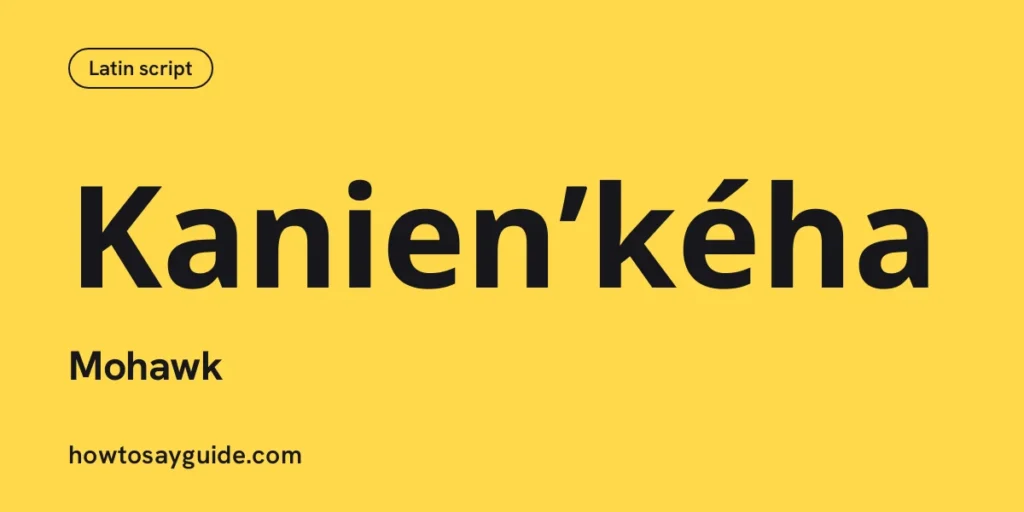
How to Say “No” in Mohawk
The English word “no” is expressed as yah in Mohawk. yah is a particle used to express negation or to show disagreement.
Mohawk, Kanien'kéha in the language itself, is spoken by the Mohawk people, one of the Six Nations of the Haudenosaunee (Iroquois) Confederacy, in communities in Quebec, Ontario and New York State. Few fluent speakers remain, and UNESCO classes it as definitely endangered, but immersion schools in communities such as Kahnawà:ke and Akwesasne are raising new speakers.
Mohawk is written with a small set of Latin letters. It has almost no sounds made with the lips, so letters such as b, f and p are not used. A colon after a vowel makes it long, and an apostrophe marks a short catch in the throat. Hello is shé:kon.
| Family | Iroquoian |
|---|---|
| Where spoken | Canada (Quebec, Ontario), United States (New York) |
| Status | definitely endangered (UNESCO) |
| Script | Latin alphabet |
| Code | moh (ISO 639-3) |
Classification: Wikidata. Retrieved 26 September 2026.
The English word “no” is expressed as yah in Mohawk. yah is a particle used to express negation or to show disagreement.
The English phrase “hello, how are you?” is translated into Mohawk as kwe, skennenko:wa ken?
The English phrase ‘how are you?’ is translated into Mohawk as Skennenkó:wa ken?
The English word “cat” is translated into Mohawk as takò꞉s. The term refers to the domestic species of cat.
The English word “peace” is translated into Mohawk as skén:nen. skén:nen is a noun used to describe a state of being free from war.
The English word “hello” is translated into Mohawk as shé:kon. shé:kon is used as an interjection to greet people.
ó:nen is the Mohawk way to say bye. ó:nen is a short form of goodbye.
The English phrase “good night” is translated into Mohawk as Sahsontiyóhak. Sahsontiyóhak is used as a farewell phrase.
In Mohawk, “good morning” is said as skén:nen kentshò:kwa. This phrase is used as a greeting when seeing someone for the first time in the morning.
The Mohawk word for grandma is aksótha. aksótha is used to refer to a grandmother in an informal way, similar to the English word granny.