How to Say “Princess” in Bulgarian
The English word princess is translated into Bulgarian as принце́са. The term is a noun used to describe a female member of a royal family.
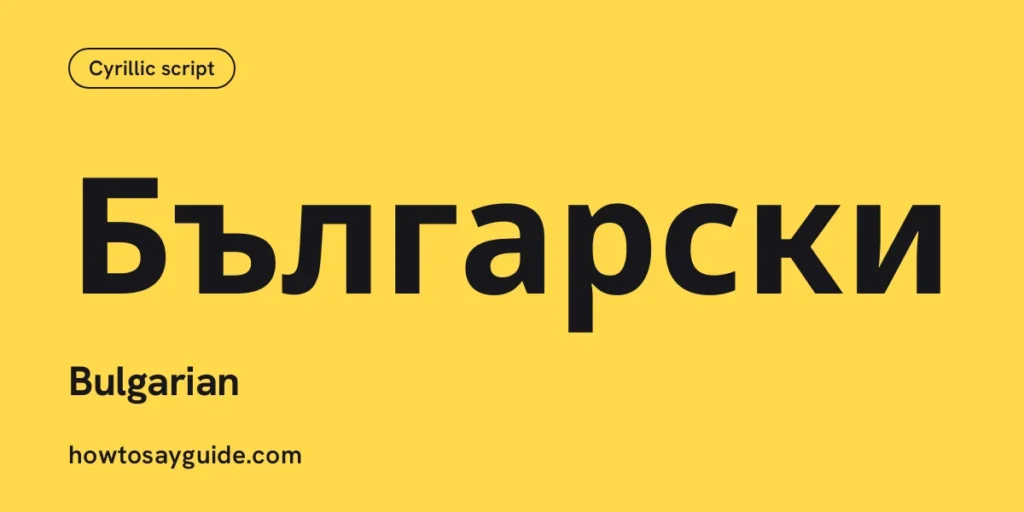
Bulgarian is the official language of Bulgaria and one of the official languages of the European Union, with about 9 million speakers in Bulgaria and abroad. It is a South Slavic language, very close to Macedonian, and the Cyrillic alphabet took shape in the medieval Bulgarian state.
Bulgarian is written in Cyrillic. Use vie as the polite "you" and ti with friends. A polite hello is zdraveyte, and to a friend zdravey. Stress can fall on any syllable and has to be learned with each word. One gesture surprises visitors: many Bulgarians nod to mean no and shake the head to mean yes.
| Family | Indo-European, South Slavic |
|---|---|
| Speakers | about 9 million (2014) |
| Official in | Bulgaria |
| Script | Cyrillic alphabet, 30 letters |
| Codes | bg (ISO 639-1), bul (ISO 639-3) |
Speaker number: The Columbia Encyclopedia (2014), via Wikidata. Retrieved 26 September 2026.
The English word princess is translated into Bulgarian as принце́са. The term is a noun used to describe a female member of a royal family.
Goodbye in Bulgarian can be expressed as дови́ждане, сбо́гом or на до́бър час. These terms are used to bid farewell.
The Bulgarian phrase for “are you okay?” is добре ли си?
The English word ‘beautiful’ can be translated into Bulgarian using several forms, most commonly краси́в.
The English phrase ‘learning’ can be translated into Bulgarian as у́чене. The term is used to describe the action of the verb.
To hurry in Bulgarian is бързам (bắrzam). The verb is used to describe the act of doing things quickly.
The Bulgarian word for the fruit orange is портока́л. портока́л is the noun used to refer to the citrus fruit.
The Bulgarian word for sleep is сън. сън refers to the state of reduced consciousness.
хляб is the Bulgarian word for bread. хляб refers to baked dough made from cereals.