How to Say “Lion” in Sinhala
The Sinhala word for lion is සිංහයා. සිංහයා is a noun used to refer to the big cat of the species Panthera leo.
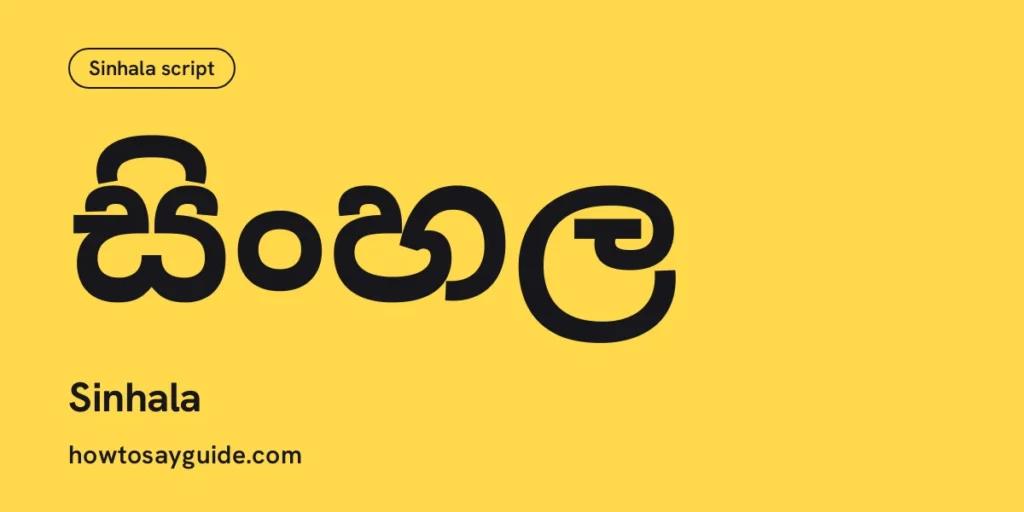
Sinhala is the first language of about 15 million people in Sri Lanka, where it is an official language together with Tamil. It is an Indo-Aryan language, distantly related to Hindi and Bengali, but it has grown on the island for more than two thousand years and has borrowed words from Tamil, Portuguese, Dutch and English.
Sinhala has its own rounded script, and the spoken language differs a lot from the formal written one, so words in a book may sound stiff in conversation. The formal greeting āyubōvan means "may you live long" and is said with palms pressed together. Sinhala has several words for "you" at different levels of respect, and many speakers avoid them by using a name or a title such as "sir" or "aunty" instead.
| Family | Indo-European, Indo-Aryan |
|---|---|
| Native speakers | about 15.3 million (2019) |
| Official in | Sri Lanka |
| Script | Sinhala script |
| Codes | si (ISO 639-1), sin (ISO 639-3) |
Speaker number: Ethnologue (2019), via Wikidata. Retrieved 26 September 2026.
The Sinhala word for lion is සිංහයා. සිංහයා is a noun used to refer to the big cat of the species Panthera leo.
The Sinhala word for “boy” is පිරිමි ළමයා. පිරිමි ළමයා is a noun used to refer to a male child.
The English word ‘beautiful’ is translated into Sinhala as ලස්සන or සුන්දර. Both words are used to describe something that is attractive.
The English word dog is translated into Sinhala as බල්ලා. The word refers to the animal known as a dog.
The Sinhala word for scissors is කතුර. කතුර refers to the tool used for cutting.
The English word ‘brother’ is translated into Sinhala as අය්යා or මල්ලි.
The English phrase hello is said in Sinhala as ආයුබෝවන් (āyubōwan) or හලෝ (halō).
The phrase “I am learning” in Sinhala is expressed as මම ඉගෙන ගන්නවා.