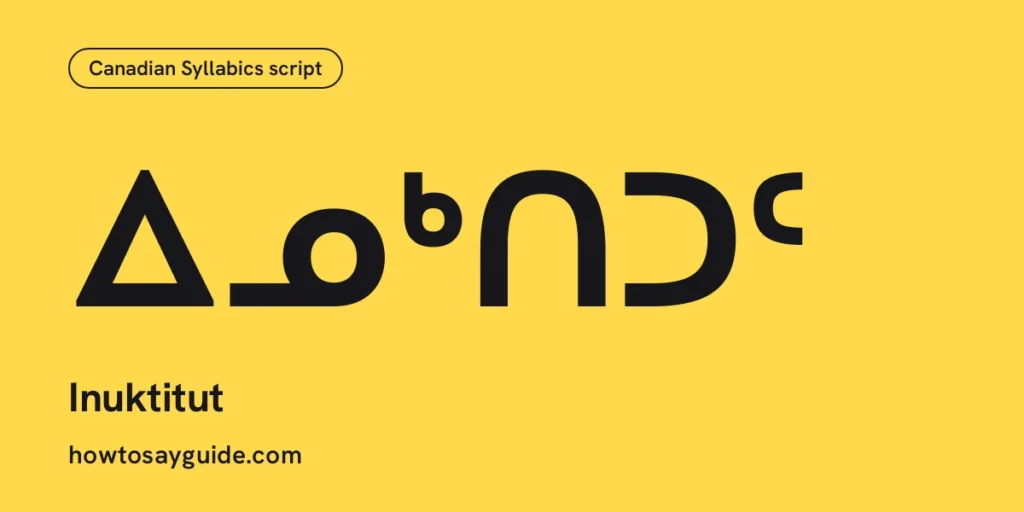
How to Say “Bear” in Inuktitut
The Inuktitut word for bear is ᓇᓄᖅ. ᓇᓄᖅ refers to a large mammal of the family Ursidae.
Inuktitut is the language of the Inuit of the eastern Canadian Arctic, spoken in Nunavut, northern Quebec (Nunavik) and Labrador. About 40,000 people reported it as their first language in the 2016 Canadian census. It is an official language of Nunavut and the Northwest Territories, and UNESCO classes it as vulnerable.
Inuktitut is written in Canadian syllabics, where each symbol stands for a syllable and turning the symbol changes the vowel, as well as in Latin letters. A single word can be very long because endings are added one after another to express a whole sentence.
| Family | Eskaleut, Inuit |
|---|---|
| Speakers | about 40,000 (2016) |
| Official in | Nunavut and Northwest Territories (Canada) |
| Status | vulnerable (UNESCO) |
| Script | Canadian syllabics, Latin alphabet |
| Codes | iu (ISO 639-1), iku (ISO 639-3) |
Speaker number: Statistics Canada, 2016 Census, via Wikidata. Retrieved 26 September 2026.
The Inuktitut word for bear is ᓇᓄᖅ. ᓇᓄᖅ refers to a large mammal of the family Ursidae.
The Inuktitut word for grandma is ᐊᓈᓇᑦᓯᐊᖅ. ᐊᓈᓇᑦᓯᐊᖅ is used to refer to a grandmother in an informal way.
The Inuktitut word for hunter is ᐊᖑᓇᓱᒃᑎ. This noun refers to a person who hunts animals.
The phrase “my name is” in Inuktitut is ᐊᑎᕋ. This phrase is used to identify oneself by stating one’s name.
The English phrase “hello” is translated into Inuktitut as ᐊᐃ. ᐊᐃ is used as a greeting.
The English phrase “happy birthday” is translated into Inuktitut as ᓇᓪᓕᐅᓂᖅᓯᐅᑦᓯᐊᕆᑦ.
The Inuktitut word for “hi” is ᐊᐃ. ᐊᐃ is used as a friendly and informal greeting.
The Inuktitut word for dog is ᕿᒻᒥᖅ. The word ᕿᒻᒥᖅ refers to the animal known as a dog.
The Inuktitut word for seal is ᓇᑦᑎᖅ (nattiq). The term refers to a seal, which is a type of pinniped.